
Beet Ravioli Stuffed with Goat Cheese, Ricotta and Mint
01 Tuesday Nov 2011
Written by tracy in Pasta
Share it
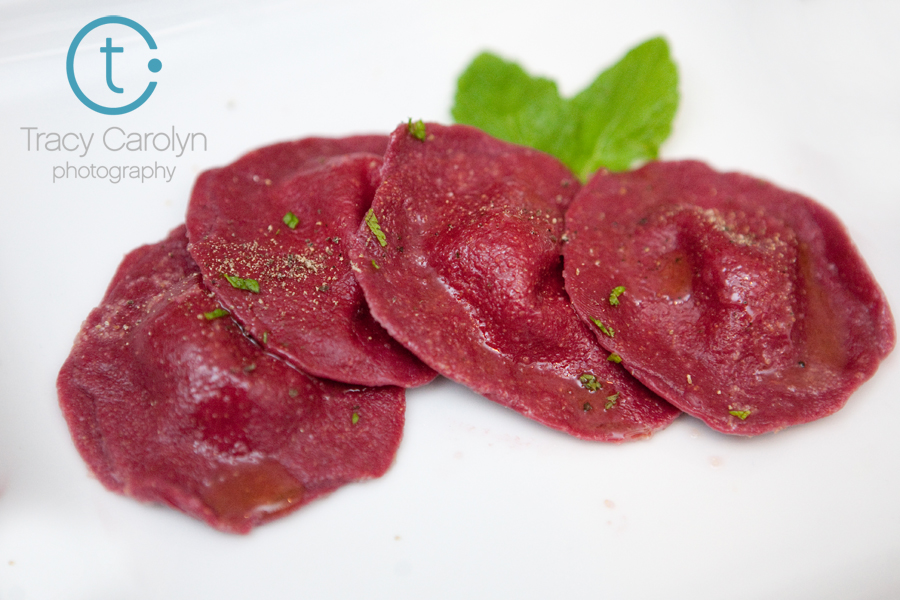
Year of the Noodle: Week 39
If a day exists when you don’t mind having blood-stained hands, it’s Halloween.
At least, faux blood-stained hands. I blame the beets. Last year they made my kitchen look like a murder scene, this year my palms looked so bloody after kneading the pasta dough for the requisite 10 minutes that it took another 5 minutes to get them reasonably clean. I don’t think I’d be accused of any crimes now, but I’d claim it was part of my Halloween costume if I did.
Beets and goat cheese make such a heavenly combination that you should ignore the blood-stained hands, cutting board, and possibly counter tops in favor of making this recipe. Or just be neater than I am and avoid the whole mess. Your call.
For the Beet Pasta
Ingredients
- 8 ounces red or golden beets (about 2 medium), without greens
- 2 teaspoons olive oil
- Coarse salt
- 2 large eggs
- 1 large egg yolk
- 2 1/2 cups all-purpose flour, plus more for dusting
- Semolina flour, for storage
Directions
- Preheat oven to 375 degrees. Toss beets with oil and a large pinch of salt. Wrap tightly in a parchment-lined piece of foil, and place on a baking sheet. Roast until tender, 45 minutes to 1 hour. Let cool. Rub beets with paper towels to remove skins. Puree in a food processor (you should have 1/2 cup puree).
- Add eggs and yolk to puree in food processor, and process until combined. Add flour and 1 heaping teaspoon salt, and process until dough just comes together, about 20 seconds.
- Transfer dough to a well-floured surface. Knead until smooth and elastic, 5 to 10 minutes, adding up to 2 tablespoons flour if dough is sticky. Place on a piece of parchment and cover with an inverted bowl, or wrap tightly in plastic; let rest for 1 to 2 hours.
- Cut dough into 8 pieces. Working with 1 piece at a time (keep the remaining pieces covered with the inverted bowl), flatten dough into an oblong shape slightly thinner than the pasta machine’s widest setting (number 1). Dust dough very lightly with flour, and feed through machine. Fold lengthwise into thirds and rotate 90 degrees. Repeat twice on same setting to smooth dough and increase its elasticity.
- Turn the dial to next narrower setting. Pass dough through twice, gently supporting it with your palm. Continue to press dough, passing it through ever-finer settings, two passes on each setting, until sheet is almost translucent and very thin but still intact (number 5 of 8 on a KitchenAid pasta roller). The dough will stretch to about 16 inches long. If dough bubbles or tears, pass it through again, and dust with flour if the dough is sticking.
- For farfalle, lasagna squares, or ravioli: Place rolled sheet on a lightly floured surface, and cut into desired shape, using a dry brush to dust flour off if needed. Cook according to corresponding recipe. For ribbon pastas: Place dough on a drying rack until slightly tacky, 10 to 15 minutes, and then cut into strands using a pasta machine, cutting attachment, or by hand. Drape over rack until strands are semidry and don’t stick together, about 20 minutes. Cook immediately, or lay in a single layer on a baking sheet dusted with semolina, cover tightly with plastic wrap, and refrigerate overnight.
For the ravioli and filling
Ingredients
- 3/4 cup fresh ricotta cheese (about 6 ounces), drained 30 minutes
- 3/4 cup fresh goat cheese (about 5 ounces), room temperature
- 2 tablespoons finely chopped fresh chives
- 2 tablespoons finely chopped fresh mint, plus small sprigs for garnish
- Coarse salt and freshly ground pepper
- 1/2 recipe Fresh Beet Pasta Dough
- Semolina flour or fine cornmeal, for dusting
- 2 tablespoons coarse salt
- Extra-virgin olive oil, for drizzling
- 6 tablespoons unsalted butter
Directions
- Make the filling: Stir together cheeses and herbs; season with salt and pepper.
- Make the ravioli: Dust a baking sheet with semolina or cornmeal. Work with each sheet of dough just after it’s been rolled. Cut sheet in half crosswise, and trim each half to a 3-inch-wide strip. Space tablespoons of filling 3 1/2 inches apart along center of 1 strip. Top with remaining strip, and gently press around filling to seal, working from center out. Using a fluted pastry cutter, cut into 3-inch squares. Transfer ravioli to sheet, and cover with a kitchen towel. Repeat with remaining pasta dough and filling. (To store, lightly dust ravioli with semolina, and refrigerate between layers of parchment in an airtight container for up to 4 hours. Alternatively, freeze ravioli in a single layer on a baking sheet, about 15 minutes, and then pack as described above; freeze for up to 1 month. Do not thaw before cooking.)
- Bring a large pot of water to a rolling boil. Add salt and half of the ravioli. Cook, stirring occasionally to separate, until edges are just tender, about 4 minutes. Using a slotted spoon, transfer to a colander to drain. Drizzle with oil, and toss gently to coat. Transfer to a bowl, and loosely cover to keep warm. Repeat with remaining ravioli.
- Meanwhile, melt butter in a small saucepan over medium heat. Cook until butter is dark golden brown and has a nutty aroma, about 4 minutes.
- Divide ravioli among plates (if first batch has cooled, return them to hot water for 15 seconds, then drain). Spoon brown butter over ravioli. Serve immediately garnished with mint.
Source: Martha Stewart