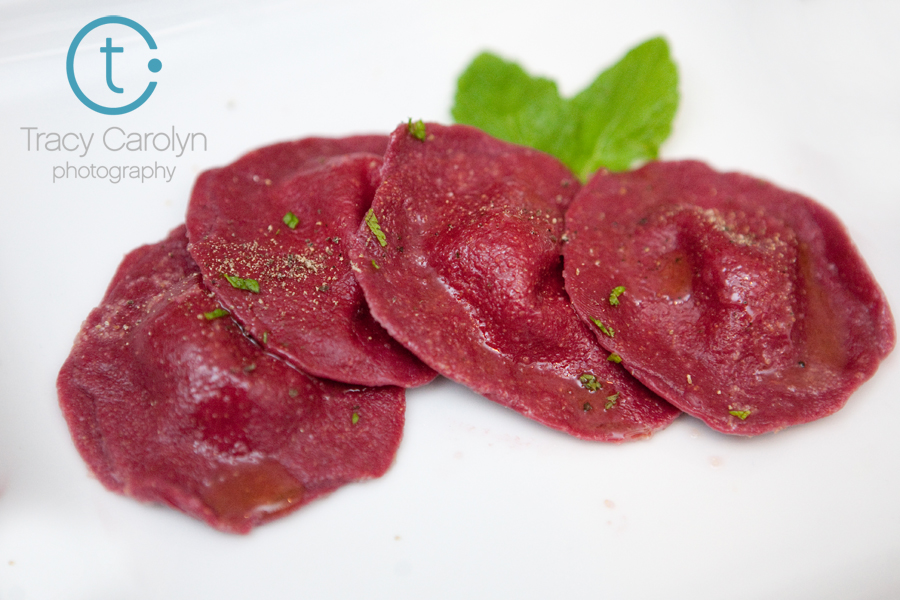
Beet Ravioli Stuffed with Goat Cheese, Ricotta and Mint

Share it

Year of the Noodle:  Week 39

If a day exists when you don’t mind having blood-stained hands, it’s Halloween.

At least, faux blood-stained hands.  I blame the beets.  Last year they made my kitchen look like a murder scene, this year my palms looked so bloody after kneading the pasta dough for the requisite 10 minutes that it took another 5 minutes to get them reasonably clean.  I don’t think I’d be accused of any crimes now, but I’d claim it was part of my Halloween costume if I did.

Beets and goat cheese make such a heavenly combination that you should ignore the blood-stained hands, cutting board, and possibly counter tops in favor of making this recipe.  Or just be neater than I am and avoid the whole mess.  Your call.

For the Beet Pasta
Ingredients
  • 8 ounces red or golden beets (about 2 medium), without greens
  • 2 teaspoons olive oil
  • Coarse salt
  • 2 large eggs
  • 1 large egg yolk
  • 2 1/2 cups all-purpose flour, plus more for dusting
  • Semolina flour, for storage
Directions
  1. Preheat oven to 375 degrees. Toss beets with oil and a large pinch of salt. Wrap tightly in a parchment-lined piece of foil, and place on a baking sheet. Roast until tender, 45 minutes to 1 hour. Let cool. Rub beets with paper towels to remove skins. Puree in a food processor (you should have 1/2 cup puree).
  2. Add eggs and yolk to puree in food processor, and process until combined. Add flour and 1 heaping teaspoon salt, and process until dough just comes together, about 20 seconds.
  3. Transfer dough to a well-floured surface. Knead until smooth and elastic, 5 to 10 minutes, adding up to 2 tablespoons flour if dough is sticky. Place on a piece of parchment and cover with an inverted bowl, or wrap tightly in plastic; let rest for 1 to 2 hours.
  4. Cut dough into 8 pieces. Working with 1 piece at a time (keep the remaining pieces covered with the inverted bowl), flatten dough into an oblong shape slightly thinner than the pasta machine’s widest setting (number 1). Dust dough very lightly with flour, and feed through machine. Fold lengthwise into thirds and rotate 90 degrees. Repeat twice on same setting to smooth dough and increase its elasticity.
  5. Turn the dial to next narrower setting. Pass dough through twice, gently supporting it with your palm. Continue to press dough, passing it through ever-finer settings, two passes on each setting, until sheet is almost translucent and very thin but still intact (number 5 of 8 on a KitchenAid pasta roller). The dough will stretch to about 16 inches long. If dough bubbles or tears, pass it through again, and dust with flour if the dough is sticking.
  6. For farfalle, lasagna squares, or ravioli: Place rolled sheet on a lightly floured surface, and cut into desired shape, using a dry brush to dust flour off if needed. Cook according to corresponding recipe. For ribbon pastas: Place dough on a drying rack until slightly tacky, 10 to 15 minutes, and then cut into strands using a pasta machine, cutting attachment, or by hand. Drape over rack until strands are semidry and don’t stick together, about 20 minutes. Cook immediately, or lay in a single layer on a baking sheet dusted with semolina, cover tightly with plastic wrap, and refrigerate overnight.
For the ravioli and filling
Ingredients
  • 3/4 cup fresh ricotta cheese (about 6 ounces), drained 30 minutes
  • 3/4 cup fresh goat cheese (about 5 ounces), room temperature
  • 2 tablespoons finely chopped fresh chives
  • 2 tablespoons finely chopped fresh mint, plus small sprigs for garnish
  • Coarse salt and freshly ground pepper
  • 1/2 recipe Fresh Beet Pasta Dough
  • Semolina flour or fine cornmeal, for dusting
  • 2 tablespoons coarse salt
  • Extra-virgin olive oil, for drizzling
  • 6 tablespoons unsalted butter
Directions
  1. Make the filling: Stir together cheeses and herbs; season with salt and pepper.
  2. Make the ravioli: Dust a baking sheet with semolina or cornmeal. Work with each sheet of dough just after it’s been rolled. Cut sheet in half crosswise, and trim each half to a 3-inch-wide strip. Space tablespoons of filling 3 1/2 inches apart along center of 1 strip. Top with remaining strip, and gently press around filling to seal, working from center out. Using a fluted pastry cutter, cut into 3-inch squares. Transfer ravioli to sheet, and cover with a kitchen towel. Repeat with remaining pasta dough and filling. (To store, lightly dust ravioli with semolina, and refrigerate between layers of parchment in an airtight container for up to 4 hours. Alternatively, freeze ravioli in a single layer on a baking sheet, about 15 minutes, and then pack as described above; freeze for up to 1 month. Do not thaw before cooking.)
  3. Bring a large pot of water to a rolling boil. Add salt and half of the ravioli. Cook, stirring occasionally to separate, until edges are just tender, about 4 minutes. Using a slotted spoon, transfer to a colander to drain. Drizzle with oil, and toss gently to coat. Transfer to a bowl, and loosely cover to keep warm. Repeat with remaining ravioli.
  4. Meanwhile, melt butter in a small saucepan over medium heat. Cook until butter is dark golden brown and has a nutty aroma, about 4 minutes.
  5. Divide ravioli among plates (if first batch has cooled, return them to hot water for 15 seconds, then drain). Spoon brown butter over ravioli. Serve immediately garnished with mint.

Source: Martha Stewart

Seeduction Bread

Share it

Whole Foods makes better bread than I do.  Let’s just get that out there right away.  But that doesn’t stop me from trying to duplicate one of our favorite items  from their bakery, the Seeduction Bread.  It’s not the cheapest bread out there, but it makes amazing peanut butter toast.

Despite not having really made bread before, when I found this recipe, I went for it.  I made a few rookie mistakes (like using AP flour instead of bread flour and possibly killing my yeast), so this was not an immediate success.  As you can see, it’s not the fluffiest loaf of bread, and it certainly isn’t suitable to slice for sandwiches.  But I’m not giving up that easily.  I’m going to do some further experimentation with bread baking and give this recipe another try.

If you have an abundance of pumpkin seeds leftover from pumpkin carving this weekend, you should give it a try, too.  Or just roast the seeds and eat them.  Probably easier.

Happy Halloween!

Ingredients
  • 1/2 cup lukewarm water
  • 2 1/2 teaspoons active dry yeast (one packet)
  • 1/4 cup honey
  • 2 3/4 cups bread flour
  • 1 cup whole wheat flour
  • 1/2 cup couscous or bulgur or cracked wheat
  • 1 1/2 teaspoons salt
  • 1/4 cup sunflower oil
  • 1 cup cool water
  • 1 cup raw sunflower seeds
  • 3 tablespoons poppy seeds
  • 1/2 cup plus 3 tablespoons raw pumpkin seeds
Directions
  1. Pour lukewarm water into a 2-cup measure and sprinkle with yeast. Mix in honey and let sit for about 10 minutes, so it gets foamy.
  2. Put flours, couscous and salt in the bowl of your food processor and pulse to combine them. Pour the sunflower oil and cool water into the yeast mixture and then, while the processor is running, pour everything through the feed tube of your food processor lid in a slow and steady stream. Let it run until the dough stops sticking to the outside walls of the processor and forms a ball. Add a teaspoon or two of water if it’s not sticky enough to form the ball, or flour if it looks too wet. Let the processor run for another minute to knead the dough.
  3. Remove the dough ball to a greased bowl and flip it once so all sides of the dough get a little greased. Cover the bowl with plastic wrap and let the dough rise in a warm spot for 2 hours.
  4. Line a baking sheet with parchment or a Silpat mat. Turn the dough out onto a clean work surface. Knead the dough a few times and form into a large oval. Sprinkle with the seeds (reserving 3 tablespoons pumpkin seeds) and fold in half. Knead the dough so that you distribute the seeds evenly. Divide the dough into two and form tight round balls. Coarsly chop the remaining pumpkin seeds and roll the tops of the dough balls in them. (You could substitute poppy seeds here.) Place on the baking sheet, cover loosely with plastic wrap, and let rise for 45 minutes to an hour.
  5. Preheat the oven to 375ºF. Bake the breads on the center rack for 35 minutes, or until they are golden and sound hollow when tapped. Cool before slicing.

Source: Codfish and Caviar

Brussel Sprouts Pasta

Share it

Year of the Noodle: Week 38

Have you ever seen how brussel sprouts grow?  It looks kinda like a short palm tree with little nubs of cabbage growing on it.  We saw people toting them around at the farmer’s market, and of course John had to have one.  (By now you should know that he is like a small child around produce.)  I’ve not eaten a lot of brussel sprouts in my life, but recently they seem to have become fashionably gourmet as I’ve been seeing them on menus and in vegetarian entrees with increasing regularity.  Somehow brussel sprouts became cool.  Which must mean that by cooking them we are cool, right?

So cool, in fact, that on the Saturday night before Halloween, when most people dressed up like pirates or slutty flight attendants went drinking and parading around downtown Denver, we stayed at home and ate brussel sprouts pasta in front of our fireplace.  We are the height of cool.

Cool or not, this recipe is a gem.  It’s fast (once you do all the prep work to your brussel sprouts, which is a tad time consuming), light, and tasty.  I ate this dish as a standalone meal, John had it alongside a steak, and we both agreed it was yummy and filling.  The flavors apparently complemented his steak quite nicely, so it might be an excellent side dish for meat eaters (or adding some grilled chicken to the mix would probably be delightful.)

Go find some brussel sprouts and make this.  It’s super tasty, very simple, and feels quite gourmet.  Win. Continue reading »

Sneaky Baked Macaroni and Cheese

Share it

Year of the Noodle: Week 37

What makes this dish sneaky?  No, it isn’t vegan.  Usually vegan recipes spell it “cheez” instead of cheese so you know what you are getting into (I find that annoying, personally.)  What makes this dish sneaky isn’t the lack of cheese (although there isn’t much), but the addition of cauliflower.  Lots of it.

I had some slight reservations about this recipe, but I was craving mac and cheese and didn’t want to make a crazy unhealthy version.  When I pureed the cauliflower, it tasted pretty good, and I started to feel better about this whole experiment.  But the end result was, well, weird.  It didn’t taste like cheese, or cauliflower.  It just tasted odd.  I gave it a second chance the next day, and it still wasn’t working for me.  In fact, it kinda made my stomach hurt.

Alas, cauliflower just isn’t a good substitute for good old fashioned butter, cream and cheese.  I can’t say I’m all that surprised.  So skip this low fat version and go for the good stuff – and leave the cauliflower behind.

Continue reading »

Chickpea Salad

Share it


I pack John’s lunch nearly every day.  There are a few staples I include on a regular basis (fruit and nuts for example), but I’m always looking for something new and easy to make for him.  This is how I discovered the world of cold bean salads.  They are an excellent addition to a packed lunch, or side dish with a dinner full of veggies that needs a little protein.  Plus you can make them on Monday and they’ll keep until Friday in the fridge – score!

I’ve already made about three different varieties for him (they were very helpful during the vegan challenge.)  This one has parmesan cheese in it, so it’s not vegan, but still yummy.  Fresh herbs are the key, so don’t scrimp and use dried.  The chickpeas will know the difference.

Ingredients
  • 15 oz canned chickpeas, drained and rinsed
  • 2 T chopped fresh basil
  • 2 T chopped fresh parsley
  • 2 T lemon juice
  • 4 T olive oil
  • 1 small garlic clove, pressed
  • 1/3 cup parmesan cheese
  • salt to taste Continue reading »